
For whom: Children and woman earthquake survivors in Turkoglu
With whom: Poçolana Works, Turkoglu Municipality and participants
When: 2023-24
The Super Adobe Children’s Library Project is an earthen building project that we have implemented together with Poçolana Works within the scope of the multi-pillar ‘Post-Disaster Reconstruction Project’ we carried out after the 6 February earthquakes. The design and construction were led by the Poçolana Works team, while the project was hosted by the Türkoğlu Municipality. In addition to members and volunteers from our association, the Koluba Collective and All Hands And Hearts teams also participated in the construction process. The lack and poor quality of socialization spaces in the tent and container cities where disaster victims continued their lives after the earthquake is the main motivation behind the project. The SuperAdobe Library aims to address this social problem through architectural practice. The structure, which functions as a library for everyone, especially children, young people, and women, will also be used for workshops and educational purposes.
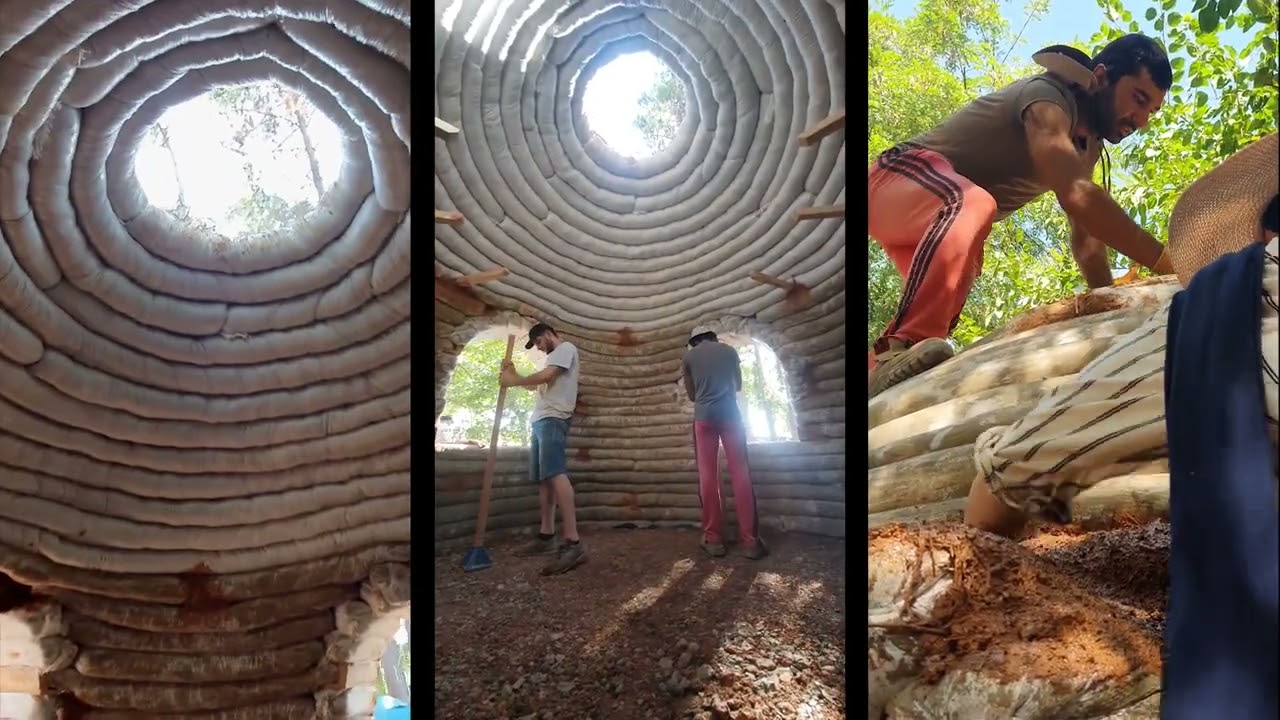
Designed to harmonize with the existing landscape within the Kahramanmaraş Türkoğlu 23 Nisan Park, the structure consists of two domes, each with a diameter of 3.5 meters. This width has been optimally arranged to ensure that the production process by the collective group, which consists of individuals with no prior experience, is not jeopardized, while also maintaining the spatial impact of the domed form. The arched doorway at the intersection of the two domes provides a transition between spaces and visual continuity. The height of the windows and the round observation windows are arranged at a child’s scale. Therefore, placing the windows lower than usual strengthens the connection between adult users and the outdoor environment while seated. The location and size of the openings in the Super Adobe structure have been determined in accordance with bioclimatic architectural criteria and the SuperAdobe Dome Design Guide which is published by CalEarth Institute.
In addition to the window openings, a fixed window decorated with stained glass is located at the top of one of the domes. This stained glass at the top has been designed to create light play within the dome and to achieve a brighter interior space during dark winter days.
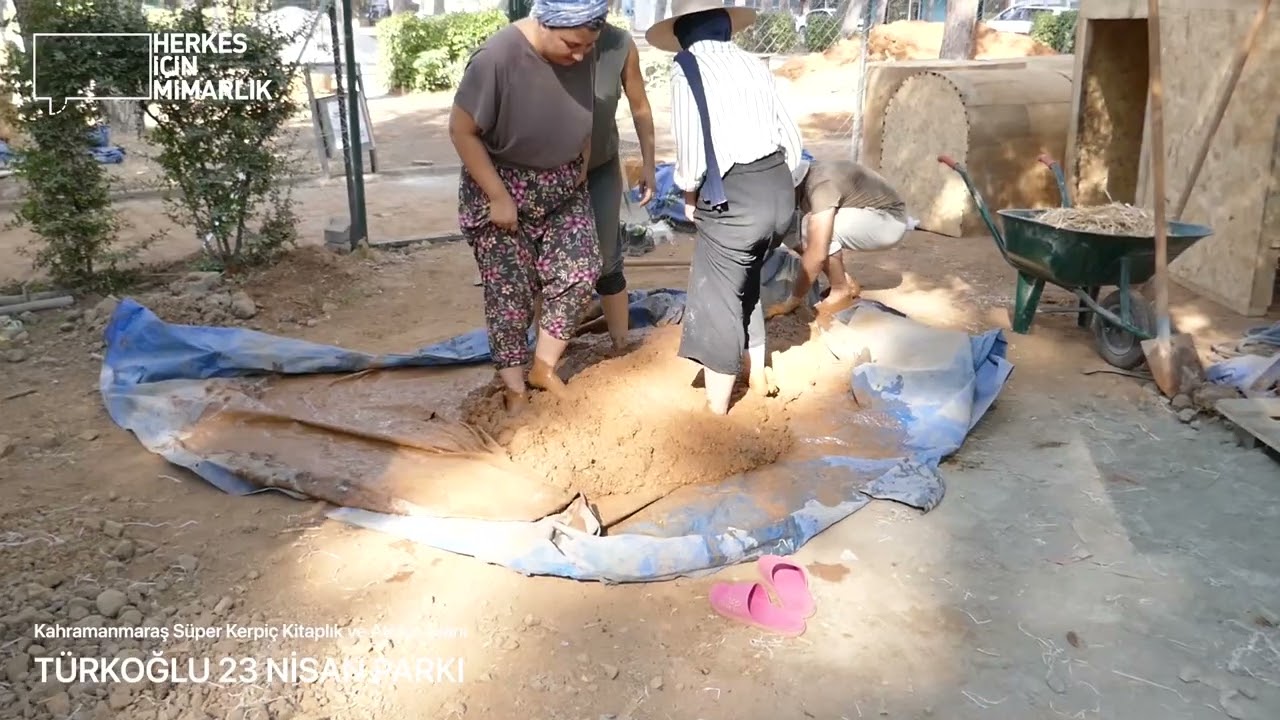
In the selection of the structure and materials for the building, criteria such as locality, accessibility, ease and speed of application, low cost, durability, interior comfort, and sustainability were considered. Within these criteria, the earth-based Superadobe construction technique was chosen, decided upon with an expert team from both academia and practice, both national and international. The main material of the Superadobe structure consists of locally sourced soil, with the particle size adjusted and mixed with a small amount of cement. The easy accessibility of the material and the low-tech construction methods enable the local population to participate in the process, learn, and even apply it in other areas.
Tests conducted in the laboratories of Istanbul Technical University (İTÜ) and Izmir Institute of Technology (İYTE) as part of the project have shown that the physical, mechanical, and water resistance properties of the soil obtained from the region are enhanced with the addition of a small amount of cement. Contrary to the common perception of adobe construction techniques, this technique has been applied numerous times worldwide, with its performance and reliability proven by the CalEarth Institute.
As with all Superadobe structures, the prepared mortar material in this project was filled into rolled bags, stacked on top of each other, compressed, and formed into a dome. To prevent the layers from slipping, barbed wire is placed between each horizontal row. All surfaces were first smoothed with a base layer of straw-infused coarse earth plaster; the interiors of the domes were finished with earth plaster, while the exterior surfaces were completed with a specially formulated lime plaster.This construction system, with a wall thickness of approximately 40 cm, creates a comfortable environment in terms of temperature and humidity, while the twin domes form a safe, stable structure against earthquakes. Additionally, with this construction technique’s modular system, organic growth can be observed [1].
The Superadobe construction technique was developed in 1984 by architect Nader Khalili, inspired by Iran’s earthen architectural tradition, and won the Aga Khan Award for Architecture in 2004. Superadobe has been used to produce temporary shelter structures in various geographies and under changing conditions, including in Iran, Pakistan, Haiti, and Jordan. It has been proven to meet UNHCR standards when built as an emergency shelter. Due to the communal nature of the earthbag technique, it allows disaster survivors to participate in the production, maintenance, and repair of housing and social spaces during the post-disaster reconstruction process, playing a significant role in the sustainability of these areas [2].
With their thermal mass effect and energy-efficient design approaches, Super Adobe structures provide maximum thermal comfort indoors with minimal energy use, outperforming conventional materials. Thanks to the thick, interlocking monolithic walls, this technique is resistant to seismic activity and has been specifically developed for use in post-disaster areas [3].
The construction of the project, which we started the design process on 7 February immediately after the earthquake, was completed with 4 construcion workshops between 2023 July and 2024 July. We would like to thank all the participants involved in these processes; Davide Frasca from CalEarth Institute for his critical consultancy in the design process, faculty members from ITU and IYTE for soil tests; Koluba Collective, who made valuable contributions with their knowledge and experience to the first construction workshop where the structure was built; Türkoğlu Municipality for its hosting and support throughout the whole process; Kahramanmaraş Metropolitan Municipality for providing the official procedures for the project location and permission; commit by MitOst, Sivil Düşün, Gaia Kosovo, Tu Berlin After the Earthquake Student Community and individual supporters for providing financial support; all 23 Nisan Park tradesmen, especially Mr. Emre for their help during the implementations and Akif Abi for all kinds of help and interest during the implementations and when we were not there.
You can access the photo album of the project here.
[1] N. Khalili, Emergency sandbag shelter and Eco-Village: Manual-How to Build Your Own with Superadobe/Earthbags. Cal Earth Press, 2008.
[2] CalEarth, “Our founder,” CalEarth. https://calearth.org/pages/our-founder
[3] K. Hunter and D. Kiffmeyer, Earthbag Building: The Tools, Tricks and Techniques. New Society Publishers, 2004.
Design Team: Andaç Güney, Betül Ergün, Burak Aydın, Cansu Dinç, Ceren Yıldırım, Davide Frasca, Elif Feyza Ünlüsoy, Emre Özen, Görkem Geyik, Hevjin Andiç, Kevser Aksoy, Kutay Koçtekin, Merve Gül Özokcu, Mina Öner, Sarper Takkeci, Selçuk Sarp Özgen, Selman Faruk Agavur, Setenay Kamazoğlu, Yağmur Kutlar
Construction Team: Abdullah Öztaş, Ahmet Can Karakadılar, Ayşenur Tuncay, Berfin Büşra Özel, Betül Ergün, Burak Köroğlu, Ceren Yıldırım, Çınar Ceyhan, Dilara Atalay, Doruk Can Koçak, Ece Sultan Karacık, Emre Gündoğdu , Esra İmer , Görkem Geyik, Işılsu Yaşar, İsa Yavuz, Kadir Koçyiğit, Kıvanç Nalezen, Koluba Kolektifi (Gülmüge Terlan, Xavier Allard), Kutay Koçtekin, Mahmut Fatih Bembeyaz, Manas Demirkasımoğlu, Mehmet Güçlü Polat, Mert Başbuğ, Merve Gül Özokcu, Mikail Yaşar, Mina Öner, Ömer Belek, Pajtim Krasniqi, Sam Price, Selçuk Sarp Özgen, Selenay Yıldırım, Şule Toptan, Urungu Kırca, Yunus Emre Rahvalı, Zelal Gezici, All Hands and All Hearts, Akif Türk, Emre Demir ve Türkoğlulular.
Consultants: Davide Frasca (CalEarth Institute), Matthieu Pedergnana (Yaşar Üniversitesi), Prof. Dr. Seden Acun Özgünler (İTÜ), Dr. Nazife Özer (İTÜ), Prof. Dr. Şenel Özdamar (İTÜ)
Furniture Design: Pajtim Krasniqi
Overhead Skylight-Vitray Design: Mehmet Güçlü Polat, Ceren Yıldırım
Graphic Design: Cansu Dinç
Electricity Project: Mer Mühendislik (Kasım Mermer)
* The project was included in the selection of Turkish Architecture Yearbook 2024.